Sort articles by: Date | Most Rates | Most Views | Comments | Alphabet


ATTACKS ON FOREIGN NATIONALS AND MEDIA COVERAGE IN KYRGYZSTAN

 28-05-2024, 08:07

ATTACKS ON FOREIGN NATIONALS AND MEDIA COVERAGE IN KYRGYZSTANMedia coverage of xenophobic attacks on foreign students and migrants should have shed light on the true causes of the violence and played an important role in informing society and mitigating intolerance. However, many aspects of the context were not reflected in the media at all. It seems, the journalists were focused on the authorities’ reports only.

The analysis showed that the media focused on the chronology of attacks against foreigners, their beatings, robberies, referring to a viral video from the Internet showing a fight between foreign students and local youth a week ago.

Media with reference to the Ministry of Internal Affairs of Kyrgyzstan informed that this very video preceded the attacks on foreigners.

The violence broke out in the late hours of May 17, lasting for more than six hours, when hundreds of Kyrgyz people targeted hostels of international students, leaving more than 40 injured.

From May 19 to May 21, 2024, in breaking news, various media outlets reported that around 20 student hostels and their private residences were attacked. Foreigners from Pakistan, India, Bangladesh lived there. But the main targets of the attacks were Pakistanis.

Three days later, on May 22, another fact suddenly appeared in the media space.

With reference to the Department of Internal Affairs of the Chui region of Kyrgyzstan, it was reported that on the night of May 17-18, when the violence occurred, a large group of aggressive people entered the sewing workshop in which "citizens of India, Bangladesh and Pakistan worked and lived.” The aggressors carried out a pogrom, destroyed property, beat foreigners, took money and iPhones, and then disappeared. They were later detained.

Also local media reported that 64 sewing shops where foreigners worked closed down after the attacks.

The first reason was the mass departure of foreign students and workers from Bishkek, on special flights sent by the Pakistani government. Second, the media wrote, Kyrgyz authorities deported migrants who had violated the migration law.

For narrative analysis, news and reports in 13 media outlets in Kyrgyzstan were analyzed randomly using AI. The analysis of 138 media contents showed that only the informational significance prevailed in the coverage of violence. There were no analytics and journalistic investigations into the causes of violence.


XENOPHOBIA, HATE AND DISCRIMINATION-2023

 29-12-2023, 03:26

 XENOPHOBIA, HATE AND DISCRIMINATION-2023The monitoring group of the School of Peacemaking has presented analytical results of the documented incidents.

The research data was collected in 2023 by both specialist researchers and monitoring methods using open-source content in the Kyrgyz and Russian languages.

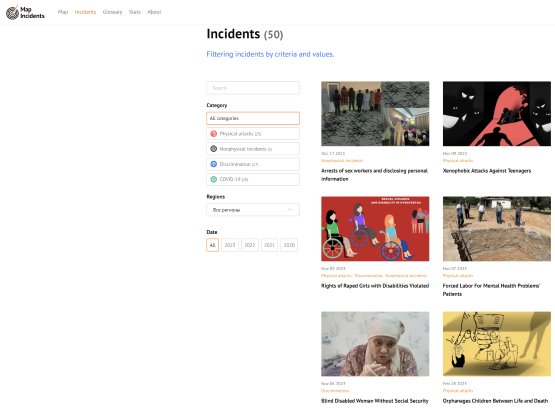
The Mapincidents in Kyrgyzstan is an open data resource, a tool for analyzing the situation and collecting cases. Statistics in the Incidents section display the number of incidents for each individual category.

This web resource displays only facts that have been documented by experts from the School of Peacemaking, the Coalition for Equality in the Kyrgyz Republic and have a certain context in the form of a media story. Many incidents remain unknown for various reasons. Based on the collected information, various reports are compiled. The final 2023 report will be published in 2024.


Photo: Screenshot of the web resource mapincidents.net
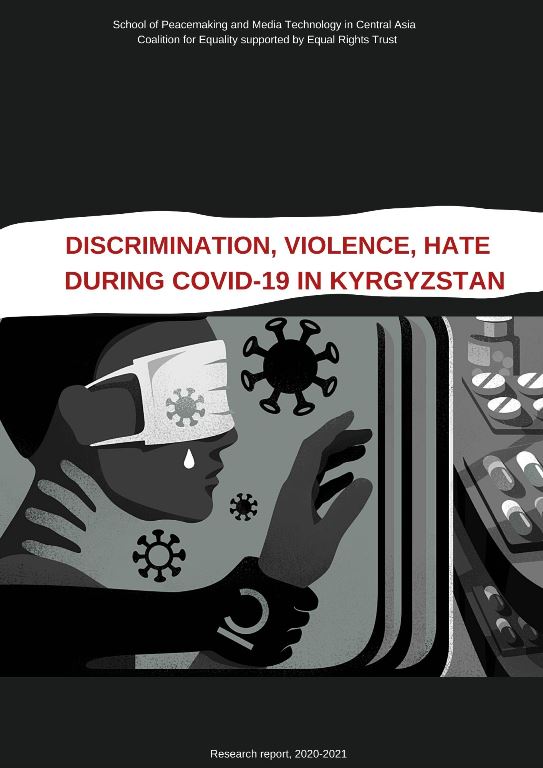


DISCRIMINATION, VIOLENCE AND HATRED DURING COVID-19

 30-08-2021, 10:02

DISCRIMINATION, VIOLENCE AND HATRED DURING COVID-19

The report shows the results of monitoring, documenting and case analysis related to discrimination and violence during the coronavirus pandemic, as well as the study of hate speech against minorities and vulnerable groups in the selected online content.

The report contains the data that cover the period from February 15, 2020 thru March 10, 2021.

The study represents the analysis of cases relating to eleven vulnerable social groups:

· female victims of violence and abduction;

· persons with disabilities, including inmates;

· internal migrants;

· labour migrants;

· the elderly people;

· people living with HIV;

· LGBT people;

· children under 15;

· foreigners victims of racial attacks;

· Muslims;

· ethnic Chinese

In addition, the report contains a separate subsection with the case of Kamil Ruziev, the human rights defender based in Karakol, Issyk Kul region. He was arrested in May 2020 on a reasoned charge and was morally coerced, surveilled and illegally questioned even though he was ill with COVID-19.
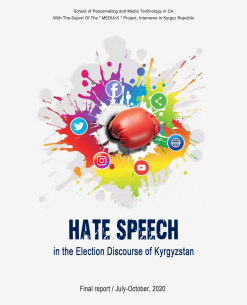


HATE SPEECH IN THE PARLAMENTARY ELECTION DISCOURSE OF KYRGYZSTAN

 1-12-2020, 11:28

HATE SPEECH IN THE PARLAMENTARY ELECTION DISCOURSE OF KYRGYZSTANFrom July 15 to October 10, 2020, the experts of the School of Peacemaking and Media Technology in CA conducted the "Hate Speech in the Election Discourse of Kyrgyzstan” study with the support of the USAID-funded Media-K project and Internews in the Kyrgyz Republic.


To successfully counteract hate speech and discrimination during election campaigns, it is necessary to improve the culture of discussion and self-expression and create models for politically correct discourses in the public space and media sphere of Kyrgyzstan.

The package of recommendations and findings is provided in the final report of a series of studies on the multilingual monitoring, documentation, analysis, and examination of hate speech and trolling in discussions concerning pre- and post-election topics.

Diagram 1. Dynamics of detected hate speech over all seven periods of media monitoring, %


The researchers analyzed the trends and dynamics of hate speech detected in the selected online media and social media content. This content was classified by type, and the team identified ten prevailing trends and their causes in each period of media monitoring. Detailed analysis of these trends is provided in the final report.[1]

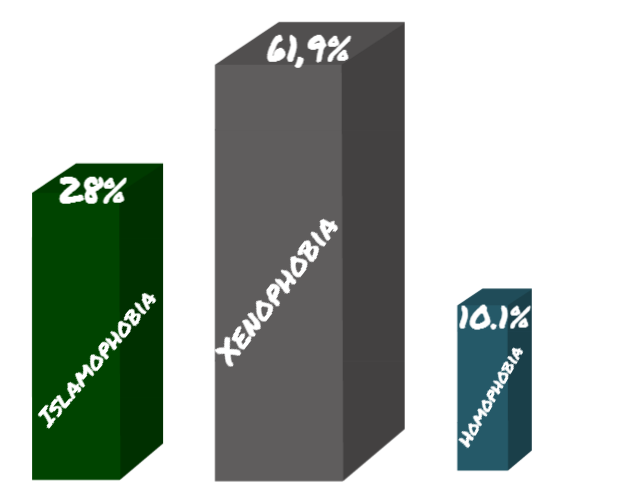
Diagram 2. Dynamics of trends by kinds of intolerance in media and online discussions in all periods, %

In their main findings, researchers noted

- the lack of quality analytical information about political parties and their platforms and candidates in the media;

- the use of hate speech in relation to the most sensitive issues for the audience on the internet and in the public sphere;

- references to the ethnic and regional affiliations of candidates and their supporters;

- language intolerance in discussions about debates; and

- gender imbalances and hate speech directed at female candidates on social media.

During the study, researchers also recorded instances of trolling, flawed argumentation and identification, accusations toward political parties and their candidates of association with someone else, divisive language, and obscene and coarse language. These phenomena were also detected in visual content.

The experts emphasize that statements and quotes in the election discourse that contained xenophobia created a demand for xenophobic content among the audience, which was expressed in the form of intolerant comments in the forums under news items published online and on social media.

The researchers recommend that authorities:

- take the September 2020 UN Strategy and Plan of Action on Hate Speech into account when developing programs;[2]

- facilitate the speedy adoption of a comprehensive anti-discrimination law in the Kyrgyz Republic;

- develop multilingual models for debates among candidates and public officials;

- train speakers to avoid hate speech and intolerance during election campaigns.


The study authors also urge donor and other international agencies to support ongoing professional monitoring and humanitarian examinations of hate speech in public discourse as well as efforts to develop a new media culture that promotes awareness of non-discrimination in public space and the importance of counteracting hate speech and that supports freedom of expression.


The study’s key recommendations are directed toward journalists and the media. These recommendations focus on the need to update editorial standards, institute exit polls to promote alternative options and develop critical thinking in the audience, and establish rules for quoting speakers who use hate speech in their statements.


"Journalists need to raise public awareness of the language of aggression in the online environment and its impact. It is important to understand network etiquette in online discussions by training voters to perceive the information they have consumed critically,” the recommendations emphasize.


This research has been made possible by the support of the American people provided via the United States Agency for International Development (USAID). The School of Peacemaking and Media Technology in CA is responsible for the content of the publications, which does not necessarily reflect the opinion of USAID, the US Government, or Internews in the Kyrgyz Republic.


About the organization. The School of Peacemaking and Media Technology in Central Asia is an organization for the development of media, public relations, the promotion of freedom of expression, and fighting hate speech and discrimination in the mass media. This organization specializes in media research and expertise on online content; the language of intolerance in the media, the internet, and public discourse; developing media campaigns on sensitive topics; and training journalists, online content developers, and human rights defenders, including in conflict zones.

www.ca-mediators.net;

https://www.facebook.com/peacemakingS/;

peacemakingschool@gmail.com


Hate Speech in Media, Internet and Public Discourse of Kyrgyzstan – 2015

 29-12-2015, 19:58

Hate Speech in Media, Internet and Public Discourse of Kyrgyzstan – 2015School of Peacemaking and Media Technologies has presented its interim report "Hate Speech in Media, Internet and Public Discourse of Kyrgyzstan – 2015”.

The report was based on the analysis of hate content carried in the surveyed print, broadcast, online media and social networks in Kyrgyz and Russian languages for November-December 2015 and data compared to other periods of the year, as well as the findings based on field studies.

The freedom of expression in the media scene of Kyrgyzstan is closely related to the lexis of hate, which is based on clearly xenophobic statements, political incorrectness and emphasizes poor journalistic standards in the media, while posts in social networks sometimes provoke network aggression. Despite the fact that Kyrgyzstan ranks higher in the Press Freedom Index[1], than the neighboring states in Central Asia, it still has problems with ethics.

The discriminatory language against minorities was also detected in those media outlets that describe themselves as analytical media. In their articles and reports about the problems faced by minorities, authors also create their negative image. Thus, the media contribute to the spreading of xenophobia – ethnic, religious, social and other types.


[1] World Press Freedom Index[1] https://index.rsf.org/#!/


Summary of the Hate Speech Report

 29-12-2015, 00:00

Summary of the Hate Speech Report


Hate speech is widely spread in the media, on the Internet, and in public discourse of Kyrgyzstan. In 2015, more than a one-third of Kyrgyzstanis have either heard, seen or read in the media the statements expressing disapproval, hatred or aggression against minorities, which, in opinion of groups studied under this research, can lead to violence.


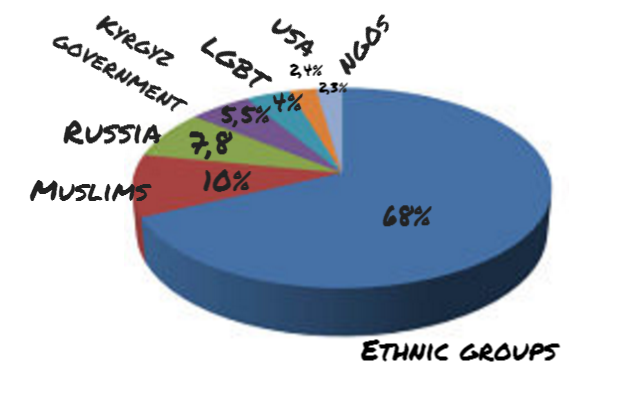
In 2015, the number of social groups that are seen as victims of hate speech and possible victims of hatred-based crimes has increased. If in previous years experts mainly identified definite ethnic groups, the analysis of the media sphere by the end of the year showed that the main target of hate speech in Kyrgyzstan are ethnic groups, Muslims and LGBT.



Peacemakingschool Launching Anti-Hate Speech Project

 10-11-2015, 00:00

Peacemakingschool Launching Anti-Hate Speech Project

The project aims to monitor and analysis of hate speech in the media and public discourse, development of recommendations, and public outreach campaign to prevent violence and discrimination against minorities in order to protect human rights and basic freedoms. 


Hate speech debates on TV expose ethical issues in media

 25-05-2015, 00:00

                            Hate speech debates on TV expose ethical issues in media School of Peacemaking and Media Technology, involved in media development and hate speech studies, has looked into the debates and comments in media and on the web that appeared after some Russian and local media outlets, online newspapers reprinted the article titled On Lions and Jackals with the subtitle Central State Channel in Kyrgyzstan Promotes Nazism.

The article was published on 19 May 2015 both on the websiteand in Moskovsky Komsomolets-Asia newspaper. It discussed inappropriate statements of Abdrakhman Alymbaev, former chairman of the National Union of Writers of Kyrgyzstan and public figure, in a TV programme Tooluktardyn Tok Shousu (Highlanders Talk Show) broadcasted on OTRK in December 2014. The host and guest of the programme were discussing the differences between ethnic groups residing in Kyrgyzstan. The author of the article in MK-Asia accused Abdrakhmanov and OTRK of "voicing Nazi ideas”.

Also, a 4-minute video demonstrating a part of this TV programme was uploaded to YouTube on May 19, 2015.

Experts of School of Peacemaking and Media Technologyfound more than 150 short articles, posts, comments that discussed this topic in media and on the web last week. The majority of publications contained hate speech, xenophobic clichés and stereotypes, dehumanising metaphors concerning both parties. When quoting public speakers commenting on this issue, journalists conveyed hate speech, which had negative impact on both the audience and commentators that were immediately involved in the debate and used offensive language.


Media Under Pressure from Political Agenda, Hate Speech, Digital Security Challenges

 6-05-2015, 02:04

Media Under Pressure from Political Agenda, Hate Speech, Digital Security ChallengesThe Kyrgyz media celebrated World Press Freedom Day 2015 with relative freedom, under pressure from the political agenda, hate speech, digital security challenges and cyber threats.

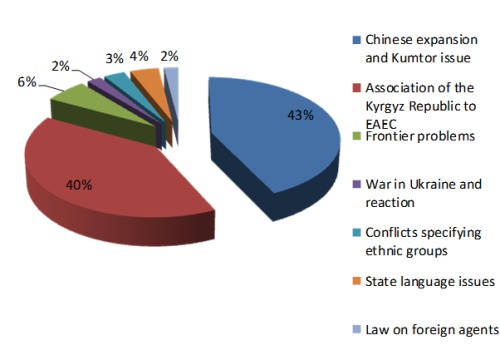
School of Peacemaking and Media Technology presented the report of freedom of expression in local media and on the internet. Experts emphasised the influence of social and political agenda on the media content. Analysis of the last four months identified 7 major topics covered mostly by the media. The majority of articles and posts were using hate speech. The leading topics covered in the media and on the internet were the Chinese expansion and Kumtor; almost the same number of stories, articles and posts raised the issue of accession of Kyrgyzstan to EAEC.



“Hate Speech in the Media and Internet in Kyrgyzstan-2014”.Annual report has presented.

 23-01-2015, 14:35
“Hate Speech in the Media and Internet in Kyrgyzstan-2014”.Annual report has presented.

School of Peacemaking and Media Technology has presented its annual report "Hate Speech in the Media and Internet in Kyrgyzstan-2014”. The report was based on the analysis on hate content carried in the surveyed print, broadcasting and online media outlets published and issued in the country in Kyrgyz and Russian languages, which were classified according to perpetrators; victims; topics, genres, types of hate speech, stereotypes and clichés.

47 media outlets most popular among audience were selected for the study. Content analysis showed that more than one-third (36.1%) of media monitored contained hate speech. Almost 56% of all articles examined contained harsh and moderate hate language.

Classification by media types identified that in 2014 print media outlets included the majority of hate speech. 41.3% of newspapers monitored contained ad hominem attacks. Then follow online media, which 27.2% of hate speech rained down on the internet, and finally TV channelsgave of hate speech 1% only.

In 2014 compared to the previous year, general trends changed a little, and hate speech vocabulary showed some growth. Distinctive trend of 2014 were retranslating stereotypes and quoting by reporters of xenophobic connotations expressed by speakers in the political arena, media texts with dubious quotes with no editorial comments.

Author’s columns often contained harsh and moderate hate speech, direct and implicit forms for accusing an ethnic group of unwelcomed willingness to settle down in the region; creating negative image of an ethnic group by covering domestic conflicts and accusations of criminality.

Kyrgyz language newspapers top the list of hate speech producers; whereas online outlets top the list among Russian language media.

Hate speech in a wide range of topics

Hate speech creates negative public images of minorities, which proportion in media texts varies based on social and political events and media reflection. In 2014, hate speech was often contained in articles/stories covering discussions on historical and border topics, where ethnic groups were accused of criminality. Hate rhetoric was detected in topics covering the Kyrgyzstan’s reaction to relations between Russia and Ukraine and sanctions against Russia, participation of Kyrgyz nationals in the war in Syria, discussion about the Kyrgyz-Canadian JV Kumtor, investment projects of China in Kyrgyzstan, forthcoming accession of the country to the Eurasian Union.



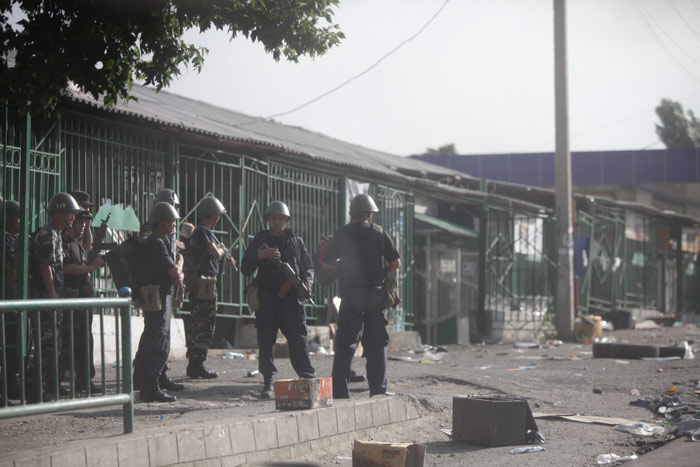
  • Military men near the aftermarket during mass clashes, Osh, June 201
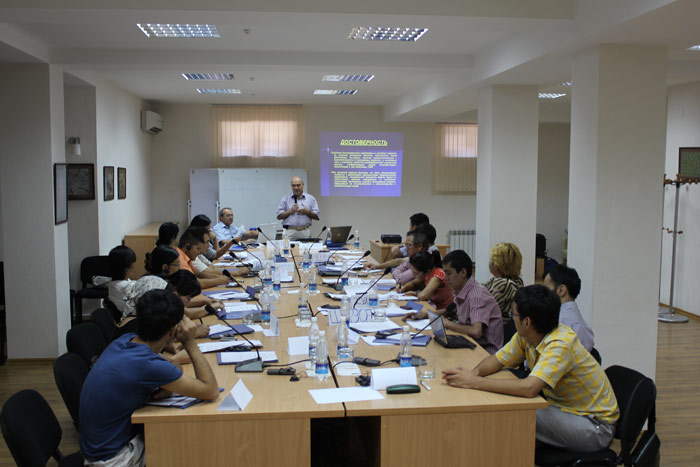
  • Training’s participants on mediation and conflict management are building the Tower of Peace, Bishkek, April 2011
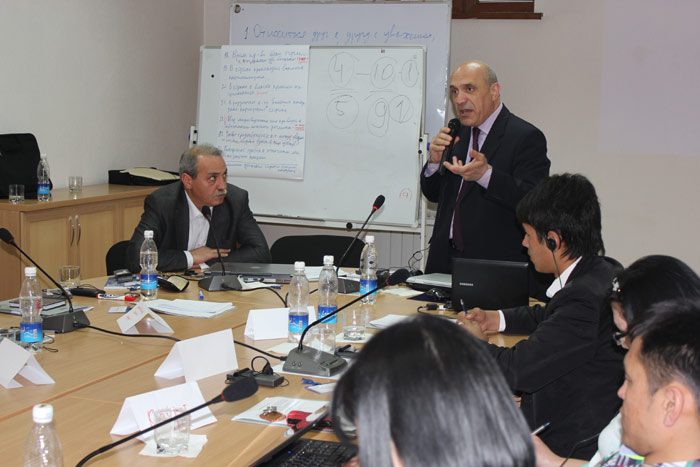
  • Training in destroying stereotypes for journalists, Bishkek, April 2012
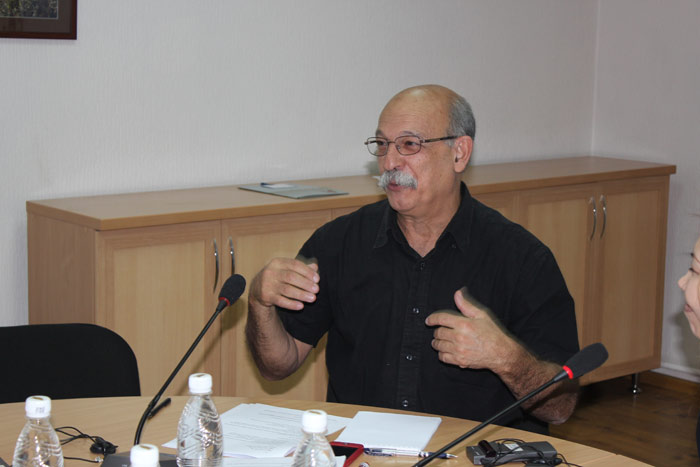
  • Workshop on production of team reporting in multinational journalist groups, Bishkek, August 2012
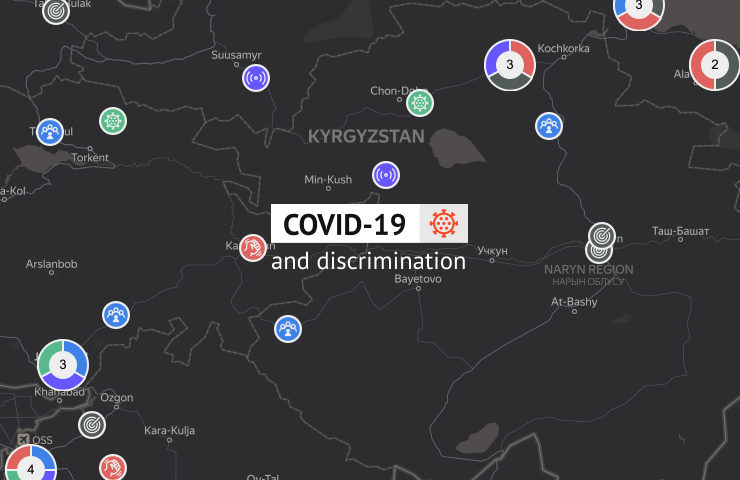


Incidents map


Education & Trainings


INTERNSHIP OPEN CALL_DEADELINE EXTENDED

The School of Peacemaking and Media Technology in Central Asia announces an annual competition among students from Kyrgyzstan, Kazakhstan,…

Подробнее

Workshops on Peacemaking Journalism


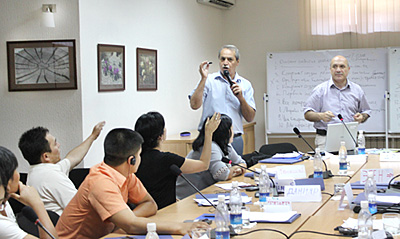
JOURNALISTS TRAINED TO COUNTER PROPAGANDA OF VIOLENT EXTREMISM

25 journalists and media workers from various regions of Kyrgyzstan have been trained to counter the propaganda of violent extremism and hate in…
Подробнее


Webinars


How to Talk About the Taliban?


How to Talk About the Taliban? Within the current context, media and journalists in Central Asia face the following dilemmas: How to cover issues happening in Afghanistan now? How to communicate information to the audience while describing the Taliban, whose image has been presented mainly in reports on terrorist attacks for almost 20 years? Can journalists offer audiences updated and redesigned narratives about a seemingly ex-terrorist group, while complying with standards and ethics?

Conflict-sensitive approaches, peace and solutions journalism tools, and new media formats can help create strategies to offer audiences a sufficiently clear and objective story.

Not Terrorists Anymore?

Kazakhstan was the first Central Asian country to officially remove the Taliban from the list of banned terrorist organisations. President Kassym-Jomart Tokayev said Astana took this step based on "the importance of developing trade and economic cooperation with present-day Afghanistan and understanding that this regime is a long-term factor”.

The Ministry of Foreign Affairs of Kyrgyzstan soon reported the same decision, emphasising that it was "aimed at strengthening regional stability and maintaining a dialogue”.

In mid-September 2024, the media reported on the "unofficial visit” of the head of Tajikistan’s State Committee for National Security Saimumin Yatimov to Kabul and his meeting with the Taliban security chiefs. It was noted that the visit was made to "strengthen bilateral relations between Tajikistan and the Taliban”.

Official Dushanbe has not yet made any statements on this, however, at the time of writing this article, the Taliban were not on the list of terrorist and extremist organisations. Economic interests play their role. Tajikistan exports electricity to Afghanistan and has reopened five markets in border towns where goods are traded on both sides. Foreign trade turnover between the two countries totalled about $46 million in the first six months of 2024.

In Uzbekistan, the Taliban were not included in the 2016 list of 22 terrorist organisations banned by the Supreme Court of Uzbekistan. After the Taliban came to power, official Tashkent opened the Uzbek-Afghan border for the delivery of essential goods and humanitarian aid.

This August, Uzbek Prime Minister Abdulla Aripov visited Kabul. According to media reports, Aripov met with Taliban leaders and discussed bilateral relations and strengthening trade and business between the two countries. As a result, five trade and investment agreements were signed in the energy, agricultural, and industrial sectors.

Turkmenistan had been in contact with the Taliban representatives even before they came to power amid growing tensions over the paramilitary attacks across Afghanistan. On September 11, 2024, in the border town of Serhetabad, Turkmenistan and the Taliban representatives relaunched the Turkmenistan-Afghanistan-Pakistan-India (TAPI) Natural Gas Pipeline Project. This large-scale project was first initiated almost 10 years ago.

The pipeline is expected to transport up to 33 billion cubic metres of natural Turkmen gas to South Asia annually.

On the one hand, the Central Asian region is becoming an important partner for Afghanistan offering infrastructure and trade projects and increasing cooperation with the regime in Kabul. This cooperation is taking place despite violations of the rights of women, girls, and minorities, restrictions on media freedom, arbitrary executions, and active calls by the UN and other international human rights bodies to put an end to such violations. The regime’s representatives in Kabul are still on the UN Security Council Consolidated Sanctions List.

On the other hand, Central Asian countries are concerned about security issues.

For example, in early September, a suicide bomber, a member of ISIS (an organisation banned in Central Asia), detonated an explosive device near the Kabul prosecutor’s office killing 6 people and injuring 13.

This fact and the length of the common Central Asian border with Afghanistan, which is more than two thousand kilometres long, pose a danger of infiltration into the region by members of ‘sleeper terrorist cells’.

Where Do We Start?

Define the unified terminology you will use in reporting on Afghanistan-related topics.

How should we describe the formerly banned and terrorist Taliban movement now?

Refer to international documents. Look up the UN-used terminology in the Case Law Database. In the latest speech of the UN High Commissioner for Human Rights Volker Türk, the regime in Kabul is referred to as the ‘de facto authorities’. This is quite a correct phrasing as it does not legitimise the authorities but only shows the reality.

In statements and reports of the European Union, the authorities in Kabul are called ‘the Taliban’. Many foreign media – BBC, CNN, Al Jazeera, and others – also use this term. For the Central Asian media, it is less acceptable because for several years, the phrase ‘the Taliban’ was necessarily labelled in brackets as ‘the terrorist and banned movement’.

The following is a list of terms that may be acceptable to use.

To use definitions correctly, it is necessary to update editorial guidelines and compile a list of terms for reporting on Afghan issues.

More precise terminology is necessary to create a balanced and impartial narrative when describing events related to Afghanistan.

What Events Should I Select for Reporting?

The most suitable topics may include:

  • Joint infrastructure projects and trade cooperation, such as the $4.8 billion Trans-Afghan Corridor railway linking Uzbekistan to Pakistan and passing through Afghanistan; building trade relations through joint business forums; new logistics routes from Turkmenistan to Afghanistan, including the Turkmenistan-Afghanistan-Pakistan-India (TAPI) pipeline.
  • Energy exports, as Afghanistan is highly dependent on electricity imports from Central Asia, which accounts for 80% of the country’s annual electricity consumption; vulnerability of the energy system due to population growth and needs.
  • Joint water use and risks. Afghanistan has already launched the second phase of the Qosh Tepa Canal construction, which diverts water from the Amu Darya River in Uzbekistan. After its construction, according to some experts’ estimates, Afghanistan will receive at least one-third of the Amu Darya water, leaving several regions of Uzbekistan and Turkmenistan facing serious water shortages.
  • Climate change and its impact on Central Asia and Afghanistan; irrigation water losses and disaster risk.
  • Security issues, countering terrorism and drug trafficking.
  • Humanitarian aid and sport.

Human Rights and Other Sensitive Topics

Many media avoid reporting on this sensitive issue amid Central Asian countries’ selective cooperation with Afghanistan. However, reporting on human rights violations is a journalist’s ethical obligation.

The exclusion of women and girls from education and employment opportunities, as well as from public spaces, continues in Afghanistan. Extreme forms of violence occur. In addition to forced early marriages and sexual violence, the Taliban has adopted a decree on public flogging and stoning women to death.

The UN Women estimates that since the Taliban came to power, they have adopted 70 documents restricting women’s rights and freedoms. Such policy is carried out with no regard for the Convention on the Elimination of All Forms of Discrimination against Women, which Afghanistan ratified in 2003.

At the end of August 2024, the law on ‘Promotion of Virtue and Prevention of Vice’ was announced by the de facto authorities, which prohibits women from saying anything out loud in public and demonstrating their faces outside the house. This law cements policies that completely erase women’s presence in public – depriving them of their autonomy, attempting to render them into faceless, voiceless shadows.

Pay attention to the following topics:

  • Gender segregation in Afghanistan. Look up the reports of international human rights organisations; they include many facts that can be used to explain the story. For example, the Amnesty International report or the Freedom in the World-2024 annual report, which ranked Afghanistan the 1st in the "Worst of the Worst” group. Read the European Parliament resolution condemning the treatment of women in Afghanistan under Taliban rule and calling for the recognition of "gender apartheid” as a crime against humanity.
  • Gender discrimination, inequality, violence, restrictions on the right to work, education, and freedom of movement; women’s mental health crisis due to constant fear and isolation. Girls are forbidden to attend schools after the 6th grade and to study at universities; women have been excluded from almost all spheres. Other regulations prohibit them from visiting parks, public baths, gyms, and beauty parlours. A minimal number of women remain employed at junior schools and women’s hospitals.
  • Ethnic discrimination and lack of an inclusive government that includes representatives of all ethnic groups living in Afghanistan. The establishment of an inclusive government during the intra-Afghan negotiations was one of the conditions of the US-Taliban Peace Deal signed in 2020. The discontent of different ethnic groups, from which discrimination arises, is centred on political participation issues. If an inclusive government was established, minorities would feel more secure. However, this condition has not been fulfilled. For example, in December 2021, representatives of ethnic Uzbeks and Turkmens living in Northern Afghanistan complained to the media that the Taliban who came to power had seized the houses and land their communities owned.
  • Even if you are writing about the economy, insert the facts into the context, reinforce the background with references to the critical human rights situation in this country. Explore the latest Afghanistan Independent Assessment requested by the UN Security Council resolution 2679 (2023), and its recommendations. It provides four general recommendations, including paying greater international attention and cooperation on issues that affect regional and global security and stability. In addition, the creation of a roadmap for political engagement aimed at Afghanistan’s full reintegration into the international community in line with its international obligations. 1

Use Teamwork to Prepare the Material

Teamwork and cross-border reporting are great methods to gather information from different sides. Create a team of journalists and experts from several countries, including Afghanistan. Identify the topic and the person responsible for finalising the gathered information.

Citations, Statistics, and Online Resources

To keep up to date, create a similar list of Afghan media and keep track of the information. Pay attention to Afghan media amu.tv, which is based abroad. It has a separate constantly updated section on cooperation with Central Asia.

When reporting on violations of women’s rights and violence against women, in addition to using international reports, monitor incidents of gender discrimination on Rukhshana.media. This is an Afghan women’s media organisation created in memory of Rukhshana, a young woman stoned to death in Ghor province for running away after a forced marriage.

Be careful with citations. If you are going to use official press releases, it will be necessary to give some explanation in brackets after phrases such as ‘Islamic Emirate of Afghanistan’ (note: This is the title of the Islamic Republic of Afghanistan used by the de facto authorities since 2021), etc. The same should be considered when republishing materials from Afghan official media. If you use Russian-language versions of Afghan websites, it is worth double-checking the information several times, as problems with translation accuracy are common.

If references to Afghan statistics are needed, you can use data from the National Statistics and Information Authority (NSIA). However, there is no comprehensive information available. There is a lack of data on the ethnic composition of the population. This problem dates to 1979, the last time a population census was conducted. After a failed attempt in 2008, another census began in 2013 and was expected to be completed in six years. According to the Minority Rights Group, it was decided that the census would not include questions on language or ethnic background for fear that the results would be too politicised and lead to another failed census. However, the census was never completed.

What Background Information Should Be Used?

Reports on issues in Afghanistan should always contain background information to better explain to the audience what is happening. Since the Central Asian aspect is more focused on the events after August 2021, it is necessary to mention the process of peace negotiations in Afghanistan, why all the conditions of the Peace Deal were not fulfilled, and how the society lived before that.

For example: "De facto authorities came to power in Kabul after the previous Afghan government led by President Ashraf Ghani collapsed amid the US troops withdrawal from the country in August 2021. Earlier, in February 2020, a Peace Deal was signed between the US and the Taliban in Doha (Qatar) after more than eighteen years. The Deal addressed a reduction in violence, withdrawal of foreign troops, the start of intra-Afghan negotiations, and guarantees that Afghanistan won’t again become a refuge for terrorists. However, the Taliban failed to fulfil several conditions of the Peace Deal. The Taliban was formed in Pakistan in the 1990s after the Soviet Union’s troops withdrew from Afghanistan. Many of its early militants were trained in Pakistani madrassas. After NATO troops’ deployment, Pakistan gave the Taliban refuge”.

Such background can be shorter or longer according to the topic you are reporting on.

If the material is to cover the state structure of Afghanistan, the focus should be on comparing the Constitution of the country legally in force since 2004 with the draft Constitution that de facto authorities proposed and then abandoned.

It is also important to note that Afghanistan is a party to several international conventions, such as the Convention Against Torture and Other Forms of Cruel, Inhuman or Degrading Treatment (1984), the Convention on the Elimination of All Forms of Discrimination Against Women (1979), the International Convention on the Elimination of Racial Discrimination (1965), the Convention on the Rights of the Child (1989), and the Convention on the Rights of Persons with Disabilities (2006). In addition, the country ratified the International Covenant on Economic, Social and Cultural Rights (1966), the Optional Protocol to the Convention against Torture (2002), the Optional Protocol to the Convention on the Rights of the Child on the involvement of children in armed conflict (2000), the Optional Protocol to the Convention on the Rights of the Child on the sale of children, child prostitution, and child pornography (2000). Explore the report describing the impact of the situation on human rights.

It is necessary to use the links to these documents in the context of human rights reporting.

Visual Design of the Materials

When using visuals, such as illustrative photos or collages, it is important to consider the nuances of traditional dress that identify different groups. If you want to show a group of Afghan men wearing dastmols (Persian: دستمال) – traditional headscarves, you need to know that these are most often soft-textured, black, grey, white, brown, mixed tones of these colours, or brown and turquoise scarves in a checked pattern.

The group of people from the de facto government can be identified by the white or black turbans on their heads. If it is not possible to find original photos, search for such illustrations.

A man wearing a red and white chequered scarf of hard texture represents Arabic or Middle Eastern style and the use of such an illustration would be wrong.

When designing visuals for the material on women’s issues, it is correct to refer to a woman’s head and face garment in the Afghan dialect as chodari (Persian: چادری) rather than burqa. It is most often a blue-coloured garment, but other colours are also found.

  1. Afghanistan is a party to UN Conventions: the Convention Against Torture and Other Forms of Cruel, Inhuman or Degrading Treatment (1984), the Convention on the Elimination of All Forms of Discrimination Against Women (1979), the International Convention on the Elimination of Racial Discrimination (1965), the Convention on the Rights of the Child (1989), and the Convention on the Rights of Persons with Disabilities (2006). In addition, the country ratified the International Covenant on Economic, Social and Cultural Rights (1966), the Optional Protocol to the Convention against Torture (2002), the Optional Protocol to the Convention on the Rights of the Child on the involvement of children in armed conflict (2000), the Optional Protocol to the Convention on the Rights of the Child on the sale of children, child prostitution, and child pornography (2000).
  1. Inga Sikorskaia is a Program Director of the School of Peacemaking and Media Technology in Central Asia, the author of several methodological guidelines for the media, and professional journalist. She has covered events in conflict zones, including Afghanistan, and worked as a chief editor for IWPR for more than 7 years. She conducts research and training on conflict and peace journalism.


More


Camp for Media Innovations


Inside View


Partners