20-04-2016, 00:00 Category: English, Education & Trainings, News
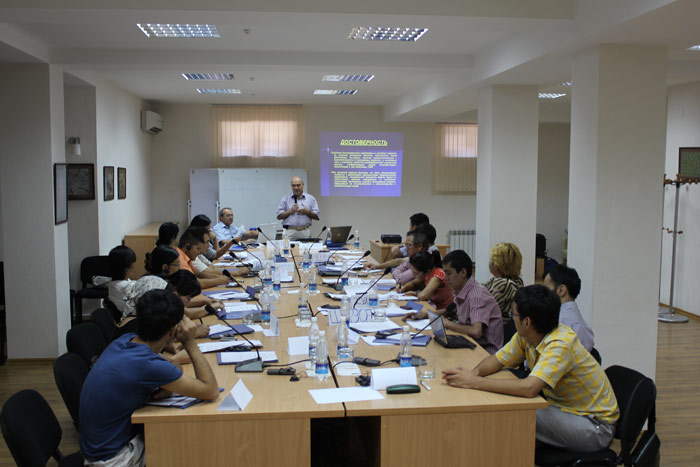
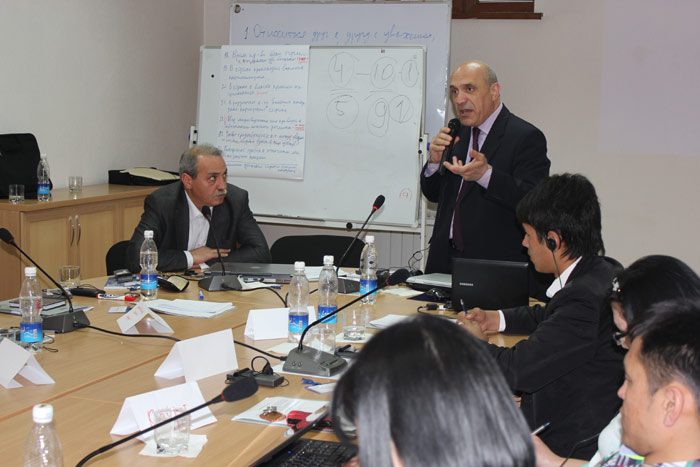
ASTANA, 19 April 2016 – An OSCE-supported two-day training seminar on protecting freedom of expression and countering hate speech on the Internet began today in Astana.
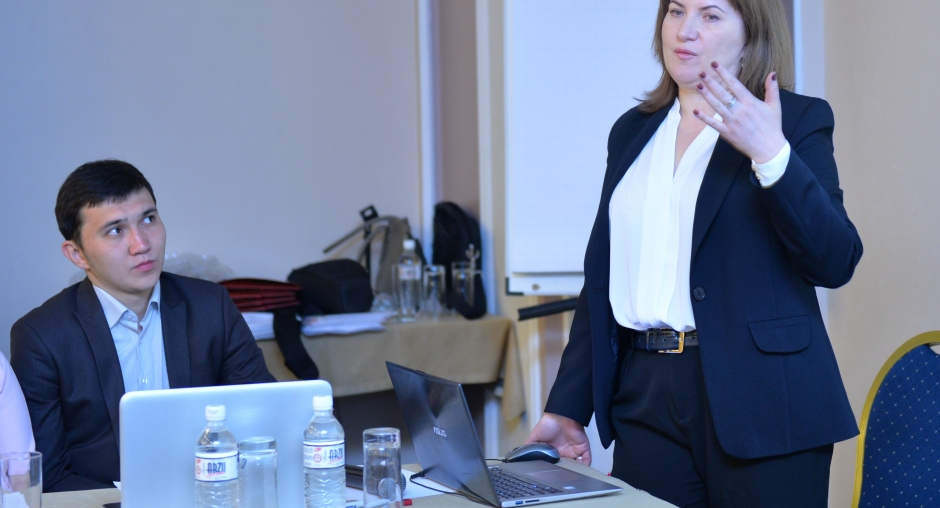
Inga Sikorskaya, Director at the School of Peacemaking and Media
Technology in Bishkek, speaking about international norms in protecting
freedom of speech and countering hate speech during the OSCE-supported
seminar, Astana, 19 April 2016. (Supreme Court of Kazakhstan)
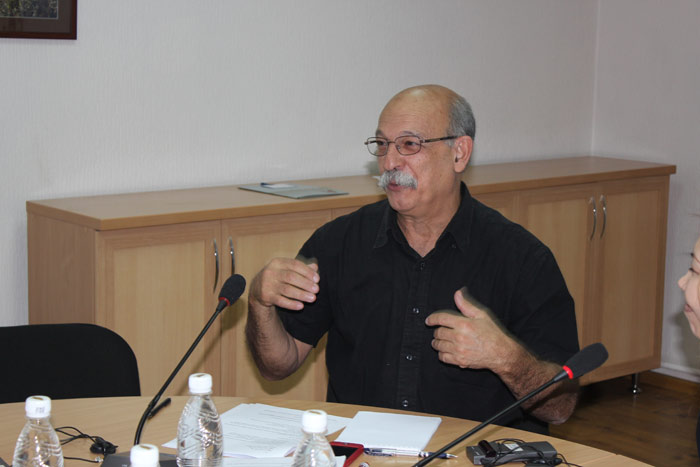
Some 40 journalists, lawyers, academics, representatives of the Justice, Interior, Investment and Development Ministries, the Prosecutor General’s Office, the Anti-terrorism Centre under the National Security Committee and Supreme Court gathered to discuss the relationship between media and hate speech policies and ways to enhance co-operation between governments, civil society and media organizations.
The event was co-organized by the OSCE Programme Office in Astana and the Legal Media Centre, a non-governmental organization based in Kazakhstan.
At the seminar, experts from Kazakhstan, Kyrgyzstan and the Russian Federation will analyse a number of selected Internet resources to identify trends in speech used by journalists and Internet users. The participants will learn the tools to counter hate speech in the media and on the Internet, mechanisms to reduce the potential harm from a malicious Internet environment and destructive human behaviour including trolling, cyber-bullying and hate speech. They will also learn how to assess text for potential conflict situations. The results of the event will allow for the further development of recommendations based on concrete practical cases.
"The Internet has become an indispensable tool for obtaining and distributing information,” said Colin McCullough, Political Officer of the OSCE Programme Office. "With its expanded use we must consider important security challenges in cyberspace, such as protecting freedom of speech while finding ways to counter content that promotes hatred and intolerance of others or may incite them to violence.”
Diana Okremova, President of the Legal Media Centre said: "According to official statistics, 88 criminal cases were filed last year under the article on "incitement of social, national, tribal, racial, class or religious hatred. Given the pace at which the Internet is developing and increasing the number of its members, this topic is becoming increasingly important and sensitive. We organized these workshops to help people understand the law and potential consequences for violating it.”
A seminar on the same topic will take place on 21-22 April in Almaty.
The event is in line with the OSCE Programme Office’s activities aimed at promoting media freedom and freedom of expression in the host country.
The School of Peacemaking and Media Technology in Central Asia announces an annual competition among students from Kyrgyzstan, Kazakhstan,…
25 journalists and media workers from various regions of Kyrgyzstan have been trained to counter the propaganda of violent extremism and hate in…
Within the current context, media and journalists in Central Asia face the following dilemmas: How to cover issues happening in Afghanistan now? How to communicate information to the audience while describing the Taliban, whose image has been presented mainly in reports on terrorist attacks for almost 20 years? Can journalists offer audiences updated and redesigned narratives about a seemingly ex-terrorist group, while complying with standards and ethics?
Conflict-sensitive approaches, peace and solutions journalism tools, and new media formats can help create strategies to offer audiences a sufficiently clear and objective story.
Not Terrorists Anymore?
Kazakhstan was the first Central Asian country to officially remove the Taliban from the list of banned terrorist organisations. President Kassym-Jomart Tokayev said Astana took this step based on "the importance of developing trade and economic cooperation with present-day Afghanistan and understanding that this regime is a long-term factor”.
The Ministry of Foreign Affairs of Kyrgyzstan soon reported the same decision, emphasising that it was "aimed at strengthening regional stability and maintaining a dialogue”.
In mid-September 2024, the media reported on the "unofficial visit” of the head of Tajikistan’s State Committee for National Security Saimumin Yatimov to Kabul and his meeting with the Taliban security chiefs. It was noted that the visit was made to "strengthen bilateral relations between Tajikistan and the Taliban”.
Official Dushanbe has not yet made any statements on this, however, at the time of writing this article, the Taliban were not on the list of terrorist and extremist organisations. Economic interests play their role. Tajikistan exports electricity to Afghanistan and has reopened five markets in border towns where goods are traded on both sides. Foreign trade turnover between the two countries totalled about $46 million in the first six months of 2024.
In Uzbekistan, the Taliban were not included in the 2016 list of 22 terrorist organisations banned by the Supreme Court of Uzbekistan. After the Taliban came to power, official Tashkent opened the Uzbek-Afghan border for the delivery of essential goods and humanitarian aid.
This August, Uzbek Prime Minister Abdulla Aripov visited Kabul. According to media reports, Aripov met with Taliban leaders and discussed bilateral relations and strengthening trade and business between the two countries. As a result, five trade and investment agreements were signed in the energy, agricultural, and industrial sectors.
Turkmenistan had been in contact with the Taliban representatives even before they came to power amid growing tensions over the paramilitary attacks across Afghanistan. On September 11, 2024, in the border town of Serhetabad, Turkmenistan and the Taliban representatives relaunched the Turkmenistan-Afghanistan-Pakistan-India (TAPI) Natural Gas Pipeline Project. This large-scale project was first initiated almost 10 years ago.
The pipeline is expected to transport up to 33 billion cubic metres of natural Turkmen gas to South Asia annually.
On the one hand, the Central Asian region is becoming an important partner for Afghanistan offering infrastructure and trade projects and increasing cooperation with the regime in Kabul. This cooperation is taking place despite violations of the rights of women, girls, and minorities, restrictions on media freedom, arbitrary executions, and active calls by the UN and other international human rights bodies to put an end to such violations. The regime’s representatives in Kabul are still on the UN Security Council Consolidated Sanctions List.
On the other hand, Central Asian countries are concerned about security issues.
For example, in early September, a suicide bomber, a member of ISIS (an organisation banned in Central Asia), detonated an explosive device near the Kabul prosecutor’s office killing 6 people and injuring 13.
This fact and the length of the common Central Asian border with Afghanistan, which is more than two thousand kilometres long, pose a danger of infiltration into the region by members of ‘sleeper terrorist cells’.
Where Do We Start?
Define the unified terminology you will use in reporting on Afghanistan-related topics.
How should we describe the formerly banned and terrorist Taliban movement now?
Refer to international documents. Look up the UN-used terminology in the Case Law Database. In the latest speech of the UN High Commissioner for Human Rights Volker Türk, the regime in Kabul is referred to as the ‘de facto authorities’. This is quite a correct phrasing as it does not legitimise the authorities but only shows the reality.
In statements and reports of the European Union, the authorities in Kabul are called ‘the Taliban’. Many foreign media – BBC, CNN, Al Jazeera, and others – also use this term. For the Central Asian media, it is less acceptable because for several years, the phrase ‘the Taliban’ was necessarily labelled in brackets as ‘the terrorist and banned movement’.
The following is a list of terms that may be acceptable to use.
To use definitions correctly, it is necessary to update editorial guidelines and compile a list of terms for reporting on Afghan issues.
More precise terminology is necessary to create a balanced and impartial narrative when describing events related to Afghanistan.
What Events Should I Select for Reporting?
The most suitable topics may include:
Human Rights and Other Sensitive Topics
Many media avoid reporting on this sensitive issue amid Central Asian countries’ selective cooperation with Afghanistan. However, reporting on human rights violations is a journalist’s ethical obligation.
The exclusion of women and girls from education and employment opportunities, as well as from public spaces, continues in Afghanistan. Extreme forms of violence occur. In addition to forced early marriages and sexual violence, the Taliban has adopted a decree on public flogging and stoning women to death.
The UN Women estimates that since the Taliban came to power, they have adopted 70 documents restricting women’s rights and freedoms. Such policy is carried out with no regard for the Convention on the Elimination of All Forms of Discrimination against Women, which Afghanistan ratified in 2003.
At the end of August 2024, the law on ‘Promotion of Virtue and Prevention of Vice’ was announced by the de facto authorities, which prohibits women from saying anything out loud in public and demonstrating their faces outside the house. This law cements policies that completely erase women’s presence in public – depriving them of their autonomy, attempting to render them into faceless, voiceless shadows.
Pay attention to the following topics:
Use Teamwork to Prepare the Material
Teamwork and cross-border reporting are great methods to gather information from different sides. Create a team of journalists and experts from several countries, including Afghanistan. Identify the topic and the person responsible for finalising the gathered information.
Citations, Statistics, and Online Resources
To keep up to date, create a similar list of Afghan media and keep track of the information. Pay attention to Afghan media amu.tv, which is based abroad. It has a separate constantly updated section on cooperation with Central Asia.
When reporting on violations of women’s rights and violence against women, in addition to using international reports, monitor incidents of gender discrimination on Rukhshana.media. This is an Afghan women’s media organisation created in memory of Rukhshana, a young woman stoned to death in Ghor province for running away after a forced marriage.
Be careful with citations. If you are going to use official press releases, it will be necessary to give some explanation in brackets after phrases such as ‘Islamic Emirate of Afghanistan’ (note: This is the title of the Islamic Republic of Afghanistan used by the de facto authorities since 2021), etc. The same should be considered when republishing materials from Afghan official media. If you use Russian-language versions of Afghan websites, it is worth double-checking the information several times, as problems with translation accuracy are common.
If references to Afghan statistics are needed, you can use data from the National Statistics and Information Authority (NSIA). However, there is no comprehensive information available. There is a lack of data on the ethnic composition of the population. This problem dates to 1979, the last time a population census was conducted. After a failed attempt in 2008, another census began in 2013 and was expected to be completed in six years. According to the Minority Rights Group, it was decided that the census would not include questions on language or ethnic background for fear that the results would be too politicised and lead to another failed census. However, the census was never completed.
What Background Information Should Be Used?
Reports on issues in Afghanistan should always contain background information to better explain to the audience what is happening. Since the Central Asian aspect is more focused on the events after August 2021, it is necessary to mention the process of peace negotiations in Afghanistan, why all the conditions of the Peace Deal were not fulfilled, and how the society lived before that.
For example: "De facto authorities came to power in Kabul after the previous Afghan government led by President Ashraf Ghani collapsed amid the US troops withdrawal from the country in August 2021. Earlier, in February 2020, a Peace Deal was signed between the US and the Taliban in Doha (Qatar) after more than eighteen years. The Deal addressed a reduction in violence, withdrawal of foreign troops, the start of intra-Afghan negotiations, and guarantees that Afghanistan won’t again become a refuge for terrorists. However, the Taliban failed to fulfil several conditions of the Peace Deal. The Taliban was formed in Pakistan in the 1990s after the Soviet Union’s troops withdrew from Afghanistan. Many of its early militants were trained in Pakistani madrassas. After NATO troops’ deployment, Pakistan gave the Taliban refuge”.
Such background can be shorter or longer according to the topic you are reporting on.
If the material is to cover the state structure of Afghanistan, the focus should be on comparing the Constitution of the country legally in force since 2004 with the draft Constitution that de facto authorities proposed and then abandoned.
It is also important to note that Afghanistan is a party to several international conventions, such as the Convention Against Torture and Other Forms of Cruel, Inhuman or Degrading Treatment (1984), the Convention on the Elimination of All Forms of Discrimination Against Women (1979), the International Convention on the Elimination of Racial Discrimination (1965), the Convention on the Rights of the Child (1989), and the Convention on the Rights of Persons with Disabilities (2006). In addition, the country ratified the International Covenant on Economic, Social and Cultural Rights (1966), the Optional Protocol to the Convention against Torture (2002), the Optional Protocol to the Convention on the Rights of the Child on the involvement of children in armed conflict (2000), the Optional Protocol to the Convention on the Rights of the Child on the sale of children, child prostitution, and child pornography (2000). Explore the report describing the impact of the situation on human rights.
It is necessary to use the links to these documents in the context of human rights reporting.
Visual Design of the Materials
When using visuals, such as illustrative photos or collages, it is important to consider the nuances of traditional dress that identify different groups. If you want to show a group of Afghan men wearing dastmols (Persian: دستمال) – traditional headscarves, you need to know that these are most often soft-textured, black, grey, white, brown, mixed tones of these colours, or brown and turquoise scarves in a checked pattern.
The group of people from the de facto government can be identified by the white or black turbans on their heads. If it is not possible to find original photos, search for such illustrations.
A man wearing a red and white chequered scarf of hard texture represents Arabic or Middle Eastern style and the use of such an illustration would be wrong.
When designing visuals for the material on women’s issues, it is correct to refer to a woman’s head and face garment in the Afghan dialect as chodari (Persian: چادری) rather than burqa. It is most often a blue-coloured garment, but other colours are also found.