 Identity disclosure, blackmailing, persecutions,
violation of privacy right, and forced emigration accompany the actions of
activists, who are in the high-risk area due to their human rights activities.
Identity disclosure, blackmailing, persecutions,
violation of privacy right, and forced emigration accompany the actions of
activists, who are in the high-risk area due to their human rights activities.
An LGBTQ+ activist (no name is given for security reasons) working in an NGO as a foreign specialist was blackmailed in Bishkek by people who identified themselves as police officers.
They showed him a screenshot of a private video, where he was captured with another man.
‘Police officers’ demanded that the activist should cooperate with them and deliver information on his colleagues upon their request. In case of denial, he was threatened with spreading this video among his acquaintances, relatives and across the country.
In fear of persecutions, the victim of blackmail left Kyrgyzstan. But when some months later he tried to get back, he failed. He was shown a document confirming he was denied entry at the border point. The document was endorsed by GKNB (State Committee for National Security of the Kyrgyz Republic). The reason for denial was not specified.
In addition to blackmail and pressure, the victim was restricted in his freedom of movement.
Despite the fact that article 29 of the Constitution of the Kyrgyz Republic ensures everyone "right to privacy”, this right of the activist was breached. Moreover, it was breached based on his sexual orientation, citizenship and human rights activity.
Another case of disclosure of SOGI (note: sexual orientation and gender identity) and private life details was published in a video about "KyrgyzIndigo”, an LGBT organization of the Kyrgyz Republic.
The video contained information and personal data of employees, their addresses and photos.
"After this information was disclosed, some employees of the NGO were spied on by unknown persons,” wrote activistsin their report "Violence and discrimination against LGBTQ+ people in the Kyrgyz Republic”[1].
Previously, Kyrgyzstan-based human rights activists had also reported cases when personal data were publicly disclosed and posed a risk for life.
Activists cite another case when during the 2020 parliamentary election in Kyrgyzstan an intimate video of two men filmed on a hidden camera was posted on the internet.
The video disclosed their names, sexual orientation, places of study and work. Victims of discrimination reported that the provocative video was published after they were blackmailed by people who identified themselves as "police officers.” According to the victims, they were demanded to disclose information about LGBTQ+ activists and human rights defenders.
"In recent years, there have been increasing incidents when LGBTQ+ activists are used for political purposes and their private life becomes public,” said Nadira Masyumova, representative of the Coalition for Equality of Kyrgyzstan. "But the state does not respond to these cases.” Analyzing these cases, Masyumova emphasized that there "are serious concerns about complicity of public servants in such cases.”
Another visible part of the LGBTQ+ community is trans* people who often become targets of media. A transgender is a man or woman, whose gender identity is different from the sex they were assigned at birth. For example, a person was assigned female at birth, and was brought up and educated as a female, but feels oneself as a male and wants to live and socialize as a male.
Several cases were documented when trans*people in bars, on the streets were filmed and their personal data were disclosed. And such cases were usually followed by physical assaults outdoors.
According to activists, only one case can be an inspiring example for LGBTQ+ people.
A trans*woman has managed to win the honour and dignity case in court against the media outlet that spread hate against her and revealed her personal information. The court awarded compensation to her in the amount of 10,000 Kyrgyz soms (115 USD dollars). However, she had to leave Kyrgyzstan for safety reasons.
This article was prepared under the project "Promoting media freedom and diversity through reporting on violation of rights and training of media workers in creating sensitive media reports on minority and marginalized groups” with the support of the Canada Fund for Local Initiative (CFLI).
[1] The shadow report was written by this NGO for the 136th session of the UN Human Rights Committee, 2022.
 Attempts to introduce inclusion into schools have faced risks from bureaucracy to violation of rights and lack of safe psychological environment.
13-year-old Nazira (not her real name) uses hearing aid that help her to better understand the world around. In early childhood, the girl had a hearing implant surgery to compensate her hearing loss.
From grade one, she studied in the special boarding school for hearing impaired children of Bishkek as she was not admitted to regular schools because of her disability. Five years later, Nazira’s mother decided to improve her development.
"I needed to place my daughter into a speaking environment,” mother said. "There [in the special school], they taught her only finger spelling [a special form of communication that used fingers – note] and sign language as there was no speaking environment.”
Nazira’s parents found a boarding school in Bishkek not far from their house. This was a secondary school of general education for orphans and children left without parental care. She was taken there for a probationary period of three months and was put into grade four for better adaptation, although she studied in grade six by that time.
Nazira’s mother was in constant contact with teachers, was interested in her daughter’s integration into the new environment, her successes in school. The teachers answered positively to all her questions.
But one case changed everything: once Nazira dodged lessons and did not return to school for a while. She was searched by parents, teachers, police. When she came home late at night, the psychological condition of the teenager was critical.
According to Nazira, her classmates laughed at her because of her hearing issues and discussed her hearing aid and disability loudly. Girl was shocked by it and could not stay in school anymore.
After the parents asked the administration to explain the incident, they learned that there was decided to suspend the girl for missing lessons. Moreover, the teachers advised taking Nazira to the special boarding school, where she had studied before.
The three laws of Kyrgyzstan ensure access to inclusive education for children with disabilities: "On education and science”, "On preschool education”, and "On rights and guarantees of persons with disabilities”. Inclusion means a form of study when all children study together regardless of their development peculiarities, level of their abilities, and diagnoses.
According to the National Statistical Committee as of March 2021, there are over 32 thousand children with disabilities under 18 in Kyrgyzstan or 1.3 per cent of total number of children of this age group. And only 10 per cent of these 32 thousand children study in special schools.
In 2019, Kyrgyzstan also ratified the International Convention on the Rights of Persons with Disabilities and the Inclusive Education Development Programme for 2019 to 2023.
However, the specialist point at a range of problems hindering inclusion in schools.
"Many funds together with the Ministry of Education and Science of the Kyrgyz Republic developed standards, methods, individual plans and even pilot projects,” said Almaz Tazhybai, director of the Centre for State Policy Analysis, which studies the enforcement of laws in educational sphere. "But [the Programme] is not yet introduced because of bureaucracy, lack of political will and allegedly because there is no money in the budget.”
Tazhybai cited other cases of violation of children’s and their parents’ rights to inclusion as an example. "Special boards established in every district send children with disabilities to special boarding schools that enrol [children] with references from the ministry of health,” he said.
Many parents want their children to study in schools with others and to have an opportunity to choose a facility of their own choice.
Another problem is the lack of psychologically safe environment in schools of general education. The case with Nazira confirms it. In school, where she tried to study, there was no special child psychologist who can work with disabled children, and teachers failed to integrate Nazira into common school environment.
Bullying by classmates and stigma have almost pushed the hearing-impaired girl to suicide.
"After that case, my daughter wanted to jump down the balcony, I could hardly talk her out of this,” Nazira’s mother said crying.
This article was prepared under the "Promoting media freedom and diversity through reporting on violation of rights and training of media workers in creating sensitive media reports on minority and marginalized groups project” with the financial support of the Canada Fund for Local Initiative (CFLI).

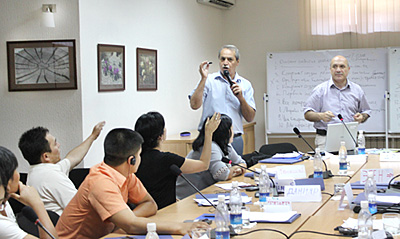
 Activists
working in NGOs on the issues of diversity, minorities and social groups from
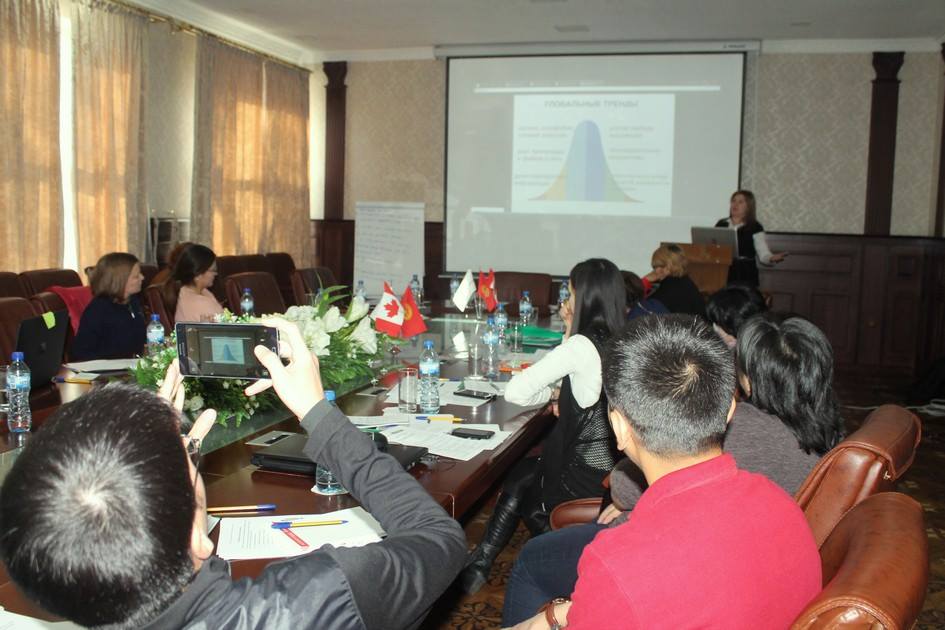
various regions of Kyrgyzstan trained effective communications with media at the workshop held in Bishkek on November 23, 2017.
Activists
working in NGOs on the issues of diversity, minorities and social groups from
various regions of Kyrgyzstan trained effective communications with media at the workshop held in Bishkek on November 23, 2017.
The training program comprised interactive sessions and practical group exercises. Participants learned about the purposes of communications and newsbreaks, learned how to make standard events interesting for media, understood to find topics that may be of interest for the audience when covering the activities of NGOs in the context of minorities issues.
A special session was dedicated to the freedom of expression, hate speech and stereotypes, and also the skills of compiling glossaries on overcoming hate speech to work with sensitive content. During intensive group games, participants practiced the skills of communicating with journalists, and learned to hold press conferences given the model situation.
Natalya Lyubeznova, a trainer of the workshop, says that effective communications between media and communities will help activists promote significant ideas and projects important for the people.
"Acquiring the interaction skills is needed to establish contacts and relations, to understand the choice of ways of community target achievement, including through the formation of a favorable attitude, which will neutralize the public negative attitude, which was shaped due to various legal initiatives focused on the reduction of civil sector activities,” Lyubeznova emphasized.
 On
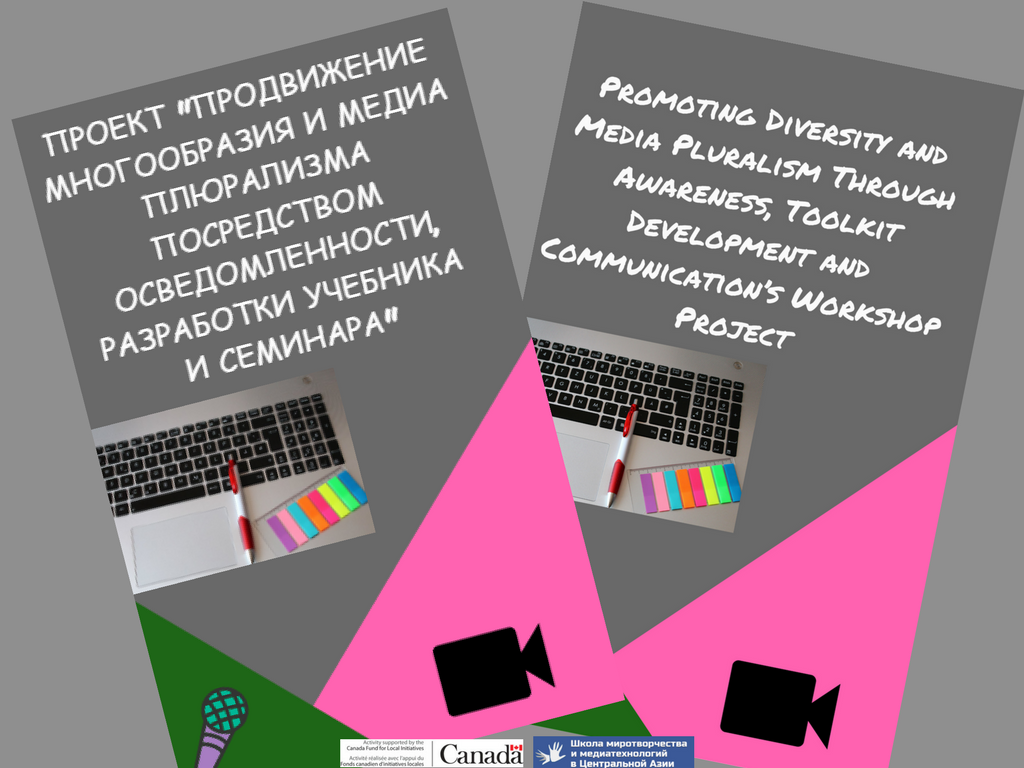
September 4, 2017, the Promoting Diversity and Media Pluralism Through Awareness,
Toolkit Development and Communication’s Workshop Project was launched.
On
September 4, 2017, the Promoting Diversity and Media Pluralism Through Awareness,
Toolkit Development and Communication’s Workshop Project was launched.
The project supported by the Canada Fund for Local Initiatives (CFLI).
The main goal of the project is to raise public awareness on diversity through groups and improve the understanding of issues and possibilities to promote pluralism. In order to achieve this goal, a whole range of consultations and meetings with local NGOs, media outlets and public authorities will be held to discuss the action plan on raising public awareness through social media campaigns.
The project staff will be monitoring the discriminatory initiatives and non-tolerance in the media and public discourse meant to constraint of diversity and pluralism in order to find out and prevent possible negative consequences, will develop and distribute the guidance on diversity for media workers and journalists, will organize a workshop on effective communications for activists working in the field of diversity and media.
"Growing non-tolerance, the increase in the number of ultranationalist vigilant groups, ethnic marginalization, violence and discrimination against women, girls, especially in rural areas, and hatred towards LGBT require new approaches in media communications between NGOs involved in minorities issues and media outlets covering such topics,” project manager Inga Sikorskaya said. "We will try to strike a happy medium in these sensitive issues and offer ways of dialog within the society.”
 School of Peacemaking and Media Technology,
involved in media development and hate speech studies, has looked into the
debates and comments in media and on the web that appeared after some Russian
and local media outlets, online newspapers reprinted the article titled On Lions
and Jackals with the subtitle
Central State Channel in Kyrgyzstan Promotes Nazism.
School of Peacemaking and Media Technology,
involved in media development and hate speech studies, has looked into the
debates and comments in media and on the web that appeared after some Russian
and local media outlets, online newspapers reprinted the article titled On Lions
and Jackals with the subtitle
Central State Channel in Kyrgyzstan Promotes Nazism.
The article was published on 19 May 2015 both on the websiteand in Moskovsky Komsomolets-Asia newspaper. It discussed inappropriate statements of Abdrakhman Alymbaev, former chairman of the National Union of Writers of Kyrgyzstan and public figure, in a TV programme Tooluktardyn Tok Shousu (Highlanders Talk Show) broadcasted on OTRK in December 2014. The host and guest of the programme were discussing the differences between ethnic groups residing in Kyrgyzstan. The author of the article in MK-Asia accused Abdrakhmanov and OTRK of "voicing Nazi ideas”.
Also, a 4-minute video demonstrating a part of this TV programme was uploaded to YouTube on May 19, 2015.
Experts of School of Peacemaking and Media Technologyfound more than 150 short articles, posts, comments that discussed this topic in media and on the web last week. The majority of publications contained hate speech, xenophobic clichés and stereotypes, dehumanising metaphors concerning both parties. When quoting public speakers commenting on this issue, journalists conveyed hate speech, which had negative impact on both the audience and commentators that were immediately involved in the debate and used offensive language.
 It is the first online handbook that
in Kyrgyzstan has never been.
It is the first online handbook that
in Kyrgyzstan has never been.
This course was developed by trainers and experts of the School of Peacemaking and Media Technology as part of the Encouraging Diversity Through Media project with financial support of the Freedom of Information Program of Soros Foundation – Kyrgyzstan.
The course is a training aid for journalists on how to cover ethnic, cultural and linguistic diversity in time of peace and conflict. Special sections provide detailed modern diversity terminology, aspects of diversity in laws and regulations of Kyrgyzstan, international practices and new approaches to diversity coverage. This course will be useful not only to reporters and editors, but also to media communication experts, teachers and students, and those who want to learn to write articles according to high ethical standards and norms.The lectures contained training aids used during trainingsessions on improving skills of journalists to cover diversity, producing team and multimedia coverage, as well as the modules on peacemaking journalism and destroying stereotypes, created as part of the Program to Reduce the Potential for Renewed Ethnic Conflict implemented in 2010-2013.
 The event was organized by the School of Peacemaking and Media Technology of the Network of Social Mediators with the financial support of the Freedom of Information Program of Soros Foundation – Kyrgyzstan as part of the Encouraging Diversity through Media project.
 TheThrough Diversity to Sustainable
Development conference to be held on November 27, 2014 in Bishkek is going
to expand the discussion on this topic.
TheThrough Diversity to Sustainable
Development conference to be held on November 27, 2014 in Bishkek is going
to expand the discussion on this topic.
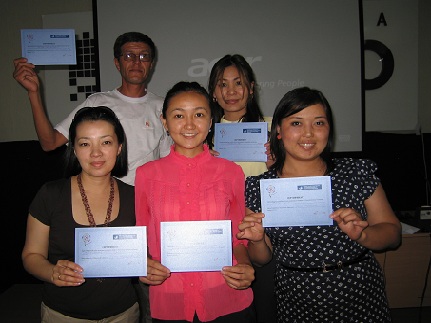 Intensive workshop was held on July 7-11, 2014 at Bishkek under the supervision of the media trainers from Spain, Kazakhstan and Kyrgyzstan, who have extensive experience in ethnic and inclusive journalism, production of multimedia product.
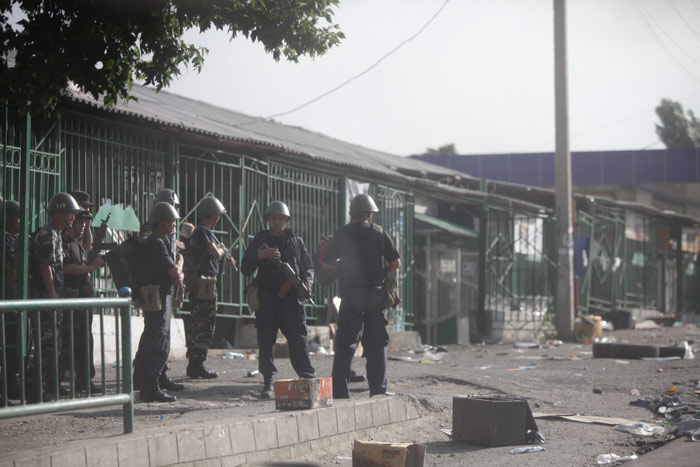
Military men near the aftermarket during mass clashes, Osh, June 201
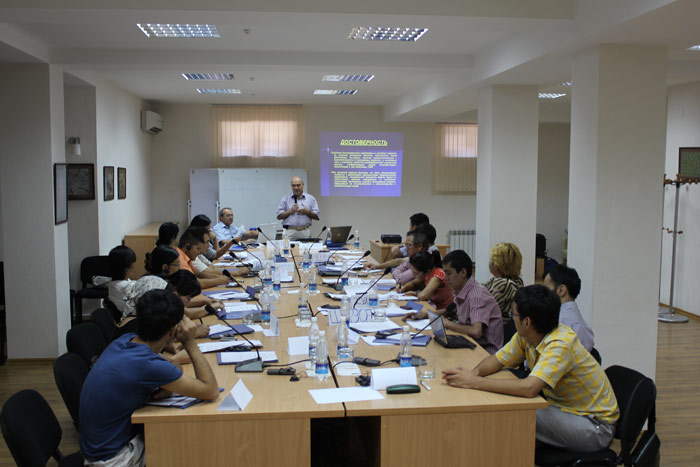
Training’s participants on mediation and conflict management are building the Tower of Peace, Bishkek, April 2011
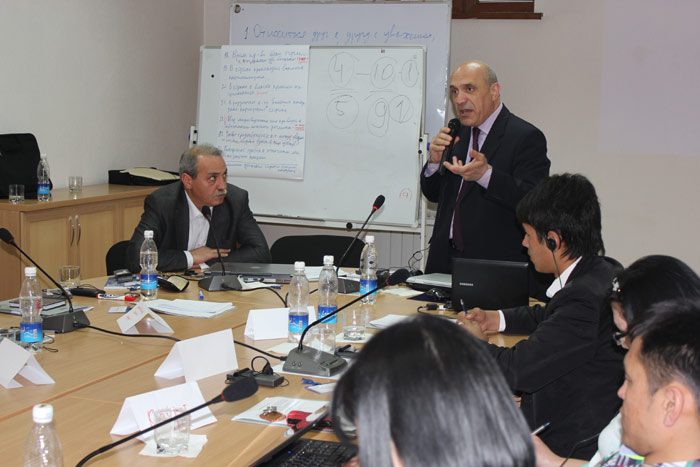
Training in destroying stereotypes for journalists, Bishkek, April 2012
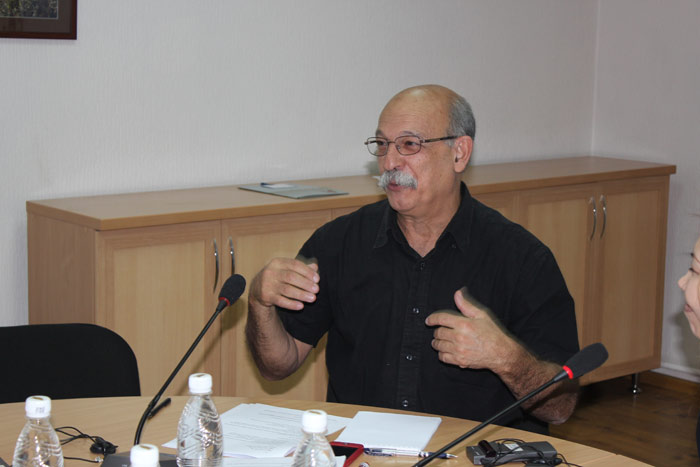
Workshop on production of team reporting in multinational journalist groups, Bishkek, August 2012

The School of Peacemaking and Media Technology in Central Asia announces an annual competition among students from Kyrgyzstan, Kazakhstan,…
25 journalists and media workers from various regions of Kyrgyzstan have been trained to counter the propaganda of violent extremism and hate in…